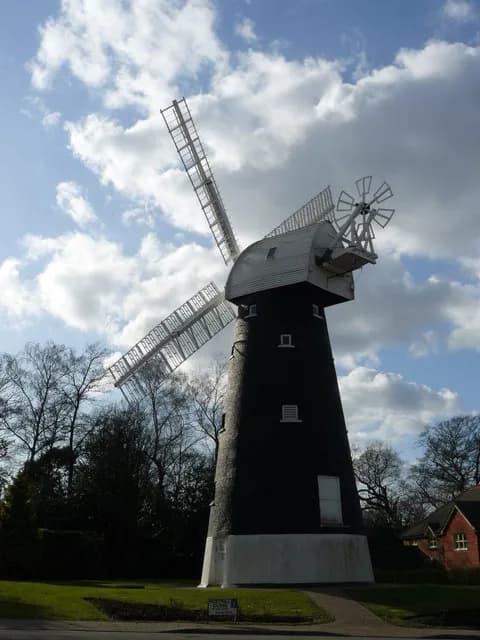
Rising 55 feet above the streets of Shirley, the five-storey brick tower on Postmill Close stands as the sole surviving windmill in Croydon. Built in 1854, Shirley Windmill is one of only four working windmills open to the public in Greater London, offering visitors a rare glimpse into the borough's agricultural and industrial heritage.
From Fire to Tower: The Alwen Legacy
The current structure owes its existence to a catastrophic fire. In October 1854, a post mill built in 1809 by Richard Alwen Senior was destroyed by flames. His son, Richard Alwen Junior, responded swiftly, commissioning a more durable replacement that same year. The new tower mill, constructed at a cost of £2,000, incorporated sophisticated engineering for its time: a Kentish-style cap that rotates automatically via an eight-bladed fantail, four double Patent sails mounted on a cast-iron windshaft, and two pairs of underdrift millstones capable of grinding grain into flour.
Some materials carried historical weight of their own. A beam bearing the date 1740 suggests timber was salvaged from an earlier mill, possibly one originally located in Stratford, West Ham, that was moved to the Shirley site around 1809.
The End of an Era
Commercial milling at Shirley ceased around 1890. Alfred Rayson, the last miller, abandoned the building in 1892 as wind-powered grinding became economically unviable. By that point, the mill was used only for animal feed. The structure remained idle for decades, surviving lightning strikes in 1899 and again in April 1906, when a sail caught fire and was saved only by the prompt action of the local fire brigade.
Shirley's survival is exceptional when viewed against Croydon's broader milling history. The borough once hosted multiple windmills: Gardiner's Mill (a post mill built in 1744 and demolished around 1814), the Black Mill (a post mill erected in 1814 and demolished circa 1855), the White Mill (a smock mill built in 1828 and demolished around 1862), and Noakes's Mill (a tower mill operational between 1852 and 1863). All have vanished. Shirley Windmill alone endures.
Preservation and Restoration
The mill's future was secured in January 1951 when it was designated Grade II listed, providing legal protection against demolition. Croydon Corporation acquired the mill and its land in 1952, a fortunate intervention given that the structure faced threats when John Ruskin School was later constructed nearby.
Subsequent decades brought significant restoration efforts. A major renovation took place in 1927. After a sail blew off in 1935, the Great Spur Wheel was replaced by Messrs Lister Brothers of Woolwich and new sails were fitted by Thomas Hunt, millwrights from Soham. In August 1996, the Heritage Lottery Fund awarded £218,100 to convert the mill into a museum. External repairs funded by Croydon Borough Council followed in 2004 and 2005.
Modern threats have emerged unexpectedly. Between 2008 and 2010, rose-ringed parakeets damaged the sails, necessitating repairs costing £45,000 by millwrights J Hole. The restoration was completed in May 2010.
Visiting Shirley Windmill
Today the mill is owned and maintained by Croydon Council, with operations managed entirely by volunteers from The Friends of Shirley Windmill. The building has been restored to working order, and much of its original 1850s machinery remains in place.
The mill opens to visitors on the first Sunday of each month from June to October, between 1pm and 5pm. It also participates in National Mills Day in May, London Open House Day in September, and Heritage Open Days. Weekday tours can be arranged in advance. Admission is free, though donations support ongoing preservation work. An adjacent Visitor Centre provides displays, refreshments, and souvenirs.
The Friends of Shirley Windmill can be contacted through their Honorary Secretary on 07880 742 545. Further information is available at shirleywindmill.org.uk.
A Living Monument
Shirley Windmill represents more than architectural heritage. It embodies the transition from agricultural to industrial Britain, demonstrates Victorian engineering capability, and illustrates the value of community-driven preservation. In a borough where four other windmills have disappeared, its continued presence offers Croydon residents tangible connection to a past that might otherwise exist only in records.