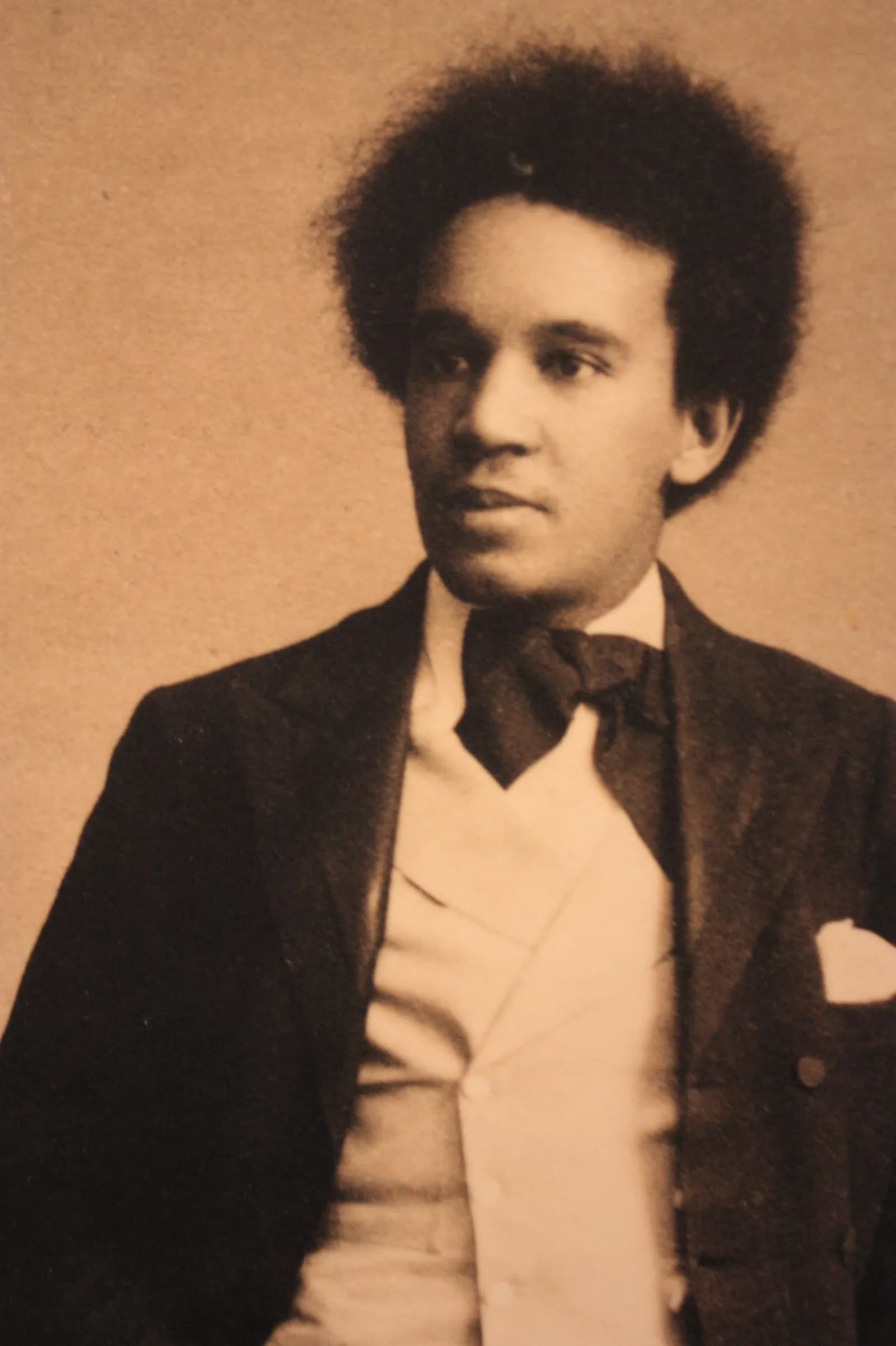
Samuel Coleridge-Taylor rose from a modest Croydon upbringing to become one of Britain's most celebrated composers, earning international acclaim and an audience with an American president before his untimely death at the age of 37.
From Holborn to Croydon
Samuel Coleridge-Taylor was born on 15 August 1875 at 15 Theobalds Road in Holborn, London. His father, Daniel Peter Hughes Taylor, was a Sierra Leone Creole doctor who had qualified at King's College London; his mother, Alice Hare Martin, was English. The couple never married, and Dr Taylor departed for West Africa early in 1875, unaware that Alice was pregnant.
In 1877, Alice brought her young son to Croydon, where they lived with her father at 67 Waddon New Road. It was here that the boy's musical gifts first emerged. His grandfather Benjamin Holmans paid for violin lessons, and an uncle provided further musical instruction. In 1887, Alice married George Evans, a railway worker, and the family settled on a street adjoining the railway line.
The Royal College of Music and Early Success
Coleridge-Taylor's talent earned him a scholarship to the Royal College of Music at the age of 15. He initially studied violin but switched to composition under Charles Villiers Stanford. Fellow composer Edward Elgar recommended him to the Three Choirs Festival in 1896; August Jaeger, an editor at Novello, declared him "a genius".
After graduation, Coleridge-Taylor was appointed professor at the Crystal Palace School of Music and later conducted the orchestra at the Croydon Conservatoire. In 1899, he married Jessie Walmisley, and the couple moved to 30 Dagnall Park in South Norwood.
The Hiawatha Phenomenon
His breakthrough came in November 1898 with the premiere of Hiawatha's Wedding Feast, a choral work setting Henry Wadsworth Longfellow's poetry. The piece was an immediate sensation. Over the following years, Coleridge-Taylor completed the trilogy with The Death of Minnehaha (1899) and Hiawatha's Departure (1900). The complete Song of Hiawatha achieved a popularity rivalling Handel's Messiah and Mendelssohn's Elijah.
Yet the composer's financial reward was meagre. He sold the rights to Hiawatha's Wedding Feast outright for 15 guineas. The work sold hundreds of thousands of copies, but Coleridge-Taylor received no royalties. His case helped spur the formation of the Performing Right Society.
International Recognition and the White House
Coleridge-Taylor undertook three concert tours of the United States, in 1904, 1906 and 1910. White orchestral musicians in New York reportedly nicknamed him "the African Mahler". In 1904, he was received by President Theodore Roosevelt at the White House, a rare distinction for a man of African descent in that era.
In 1900, he attended the First Pan-African Conference in London as its youngest delegate, meeting W. E. B. Du Bois and the poet Paul Laurence Dunbar. An African-American chorus of 200 voices, founded in Washington, D.C. in 1901, was named the Samuel Coleridge-Taylor Society in his honour. Schools in Louisville, Kentucky and Baltimore, Maryland also bear his name.
Croydon's Lasting Memorials
Coleridge-Taylor spent his final years at Aldwick, 6 St Leonard's Road, near Duppas Hill. He died there on 1 September 1912 from pneumonia, attributed by contemporaries to overwork and financial strain. He was 37.
Croydon remembers its most famous composer with two English Heritage blue plaques: one at Dagnall Park (erected in 1975, making him the first black recipient of a blue plaque) and another at St Leonard's Road, unveiled in December 2012. A metal figure stands in his likeness in Charles Street. In February 2012, the world première of his opera Thelma took place at the Ashcroft Theatre, a century after his death.
His works continue to find new audiences. The BBC Proms have recently premiered his Symphony in A minor (2021) and Four Novelletten (2023), introducing this Croydon-born composer to a new generation.