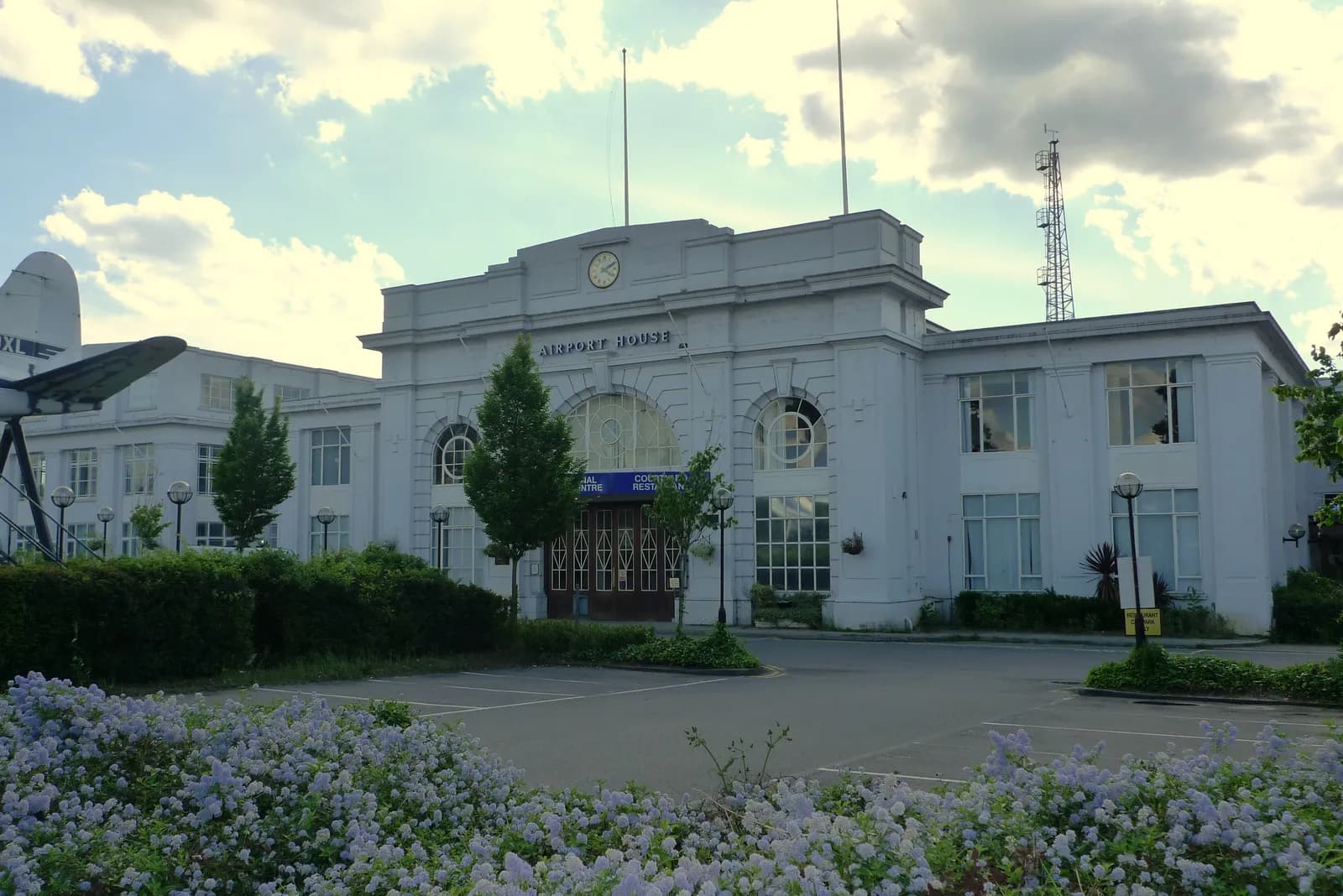
Croydon Airport was Britain's first major international airport and the birthplace of modern air travel infrastructure. From its Purley Way location, it pioneered the systems and standards that would become the global norm for airports worldwide.
The First Purpose-Built Terminal
Croydon Airport opened as London Terminal Aerodrome on 29 March 1920, replacing Hounslow Heath as the capital's primary airfield. A new permanent terminal opened on Purley Way on 20 January 1928, officially inaugurated on 2 May 1928 by Lady Maud Hoare. This building was the world's first purpose-built airport terminal, incorporating the first integrated air traffic control tower — a design format now standard at airports globally.
The control tower itself had been commissioned on 25 February 1920, making it the first of its kind. On 22 February 1922, G.J.H. "Jimmy" Jeffs received Licence No. 1, becoming Britain's first certified air traffic control officer. Senior Radio Officer F.S. "Stanley" Mockford invented the "Mayday" distress call at Croydon in 1923; it was adopted internationally in 1927.
The Interwar Glory Years
The airport became headquarters of Imperial Airways on 31 March 1924 — Britain's first national airline. From Croydon's runways, Imperial Airways established routes across the British Empire: first flights to India departed on 27 December 1926, to Cape Town on 20 January 1932, to Singapore on 9 December 1933, and to Brisbane on 8 December 1934.
Croydon became a launchpad for record-breaking aviators. On 5 May 1930, Amy Johnson departed in her de Havilland Gipsy Moth Jason for Darwin, Australia. She arrived 24 May 1930 after 11,000 miles and 19.5 days, becoming the first woman to fly solo from London to Australia. Her return to Croydon on 4 August 1930 drew a crowd of 200,000; King George V awarded her the CBE.
Other notable arrivals included Charles Lindbergh in 1927, attracting over 100,000 spectators. Bert Hinkler, Alan Cobham, Mary Bailey, and Charles Kingsford Smith all made record flights from Croydon. Winston Churchill took flying lessons there, surviving a near-fatal takeoff crash. Prince Albert, later George VI, gained his wings at Croydon in 1919 — the first royal family member to learn to fly.
Wartime Service
The airport closed to civil aviation on 1 September 1939, becoming RAF Croydon under Fighter Command. During the Battle of Britain, No. 111 Squadron saw its first major engagement on 10 July 1940. On 15 August 1940, Luftwaffe bombers attacked Croydon in error — their intended target was RAF Kenley. Six airfield personnel and 62 civilians were killed, and the terminal sustained heavy damage.
RAF Transport Command formed at Croydon on 25 March 1943. By 1943, annual passenger numbers peaked at over 230,000 as the airfield moved troops and refugees. The airport's final scheduled flight departed on 30 September 1959 at 18:15; the last aircraft left at 19:45, and the airfield officially closed at 22:20.
What Remains Today
Airport House, the former terminal, received Grade II listing in 1978 and was upgraded to Grade II* in May 2017. The control tower houses the Croydon Airport Visitor Centre, opened in 2000 and open the first Sunday of each month. A de Havilland Heron aircraft — the type that flew the last passenger service — stands on the forecourt.
The Roundshaw housing estate now occupies much of the former airfield, built from 1965 with 1,800 homes. Roads bear aviation names: Mollison Drive, Lindbergh Road, and others. Amy Johnson Primary School sits on the former runway site. A 400-foot section of runway remains in Roundshaw Park. St Paul's Church, Roundshaw, contains a cross made from a Spitfire propeller from an aircraft based at Croydon during the war.
Croydon Airport's innovations — the integrated terminal and control tower, standard air traffic procedures, and the universal Mayday call — established the template for modern aviation. What began on Purley Way in 1920 shaped how the world takes flight.